Three Months Until Year-End: What Is Your HR Data Telling You?
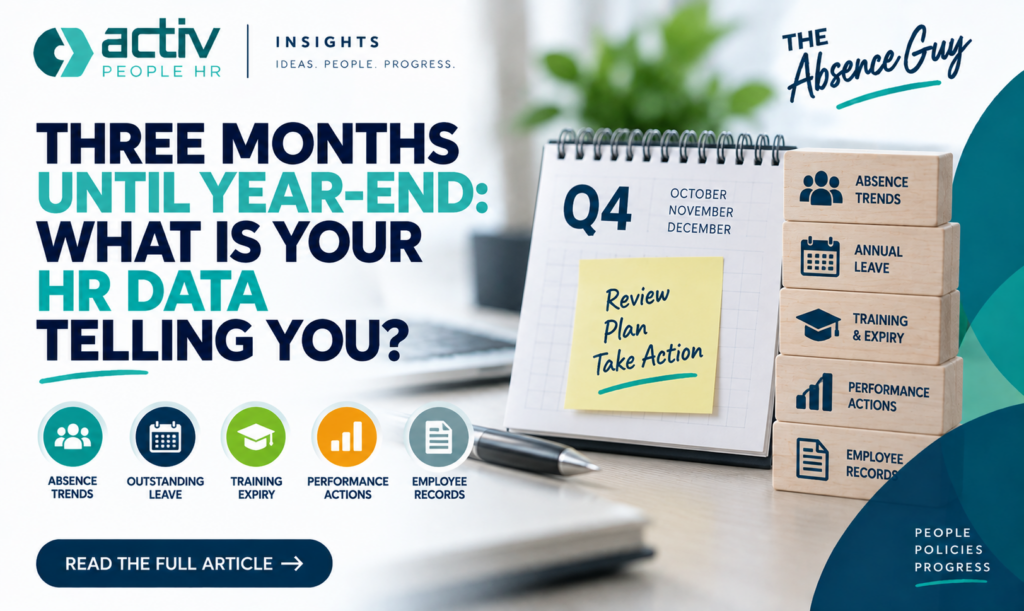
September is nearly over. That means your organisation now has nine months of 2026 HR data.
Absence records. Holiday requests. Training records. Performance reviews. Employee documents.
But having HR data and using HR data to make better decisions are two very different things.
With three months of the year remaining, now is a good opportunity to look at what your workforce data has been telling you since January and decide whether anything needs attention before 2027.
Don’t just report the numbers. Ask what they mean.
HR systems can collect huge amounts of information.
The danger is that organisations become good at recording information without necessarily doing anything with it.
An absence gets logged. A holiday gets approved. A training record gets updated. A performance review gets completed.
Job done?
Not necessarily.
The real value comes when you step back and look across that information for patterns, gaps and actions.
As we enter Q4, here are five areas worth reviewing.
1. Absence: Are patterns starting to emerge?
Looking at your overall absence rate is useful, but it doesn’t tell you everything.
Dig a little deeper.
- Are particular teams experiencing more absence than others?
- Are the same employees having repeated periods of short-term absence?
- Are particular reasons for absence becoming more common?
- Are you seeing patterns around certain days, shifts or times of year?
- And importantly, are managers acting when your absence procedures say they should?
Nine months of data should give you enough information to start identifying patterns that may not have been obvious earlier in the year.
Spotting them now gives you an opportunity to investigate and, where appropriate, intervene before they continue into 2027.
2. Annual leave: Who still has too much outstanding?
Annual leave can easily become a Q4 problem.
Employees may have built up significant unused entitlement, creating a rush for time off during November and December.
That can leave managers trying to balance employee requests against operational requirements.
Your HR data should tell you who has significant leave remaining.
Rather than waiting for employees to notice their balance in December, managers can start conversations now.
Encouraging employees to take their entitlement throughout the year isn’t simply an administrative exercise. Taking proper breaks is important for wellbeing, and it also helps organisations avoid an end-of-year leave bottleneck.
3. Training: What’s about to expire?
Training and qualification records are another area where good data should help you look forward rather than backwards.
Ask:
- Are any mandatory training courses approaching expiry?
- Are professional qualifications or licences due for renewal?
- Have employees completed training assigned earlier in the year?
- Are there outstanding development actions from previous reviews?
For some organisations, an expired qualification or missed compliance requirement can have consequences far beyond HR administration.
The objective should be to know what’s coming before it becomes overdue.
4. Performance: Did those objectives actually go anywhere?
Think back to the objectives set at the beginning of 2026.
- What happened to them?
- Were they reviewed?
- Were managers and employees having regular conversations throughout the year?
- Were agreed actions completed?
- Have objectives changed as business priorities have changed?
Too often, performance management becomes an annual event rather than an ongoing conversation.
Q4 provides a natural opportunity to review progress while there is still time to act.
It also means that when you start setting objectives for 2027, you’re doing so with a clear understanding of what happened in 2026.
5. Employee records: Is everything still accurate?
Employee information changes constantly.
People move home. Roles change. Salaries change. Managers change. Contracts get amended. New documents and policies are issued.
- But do your records reflect those changes?
- Before year-end, consider reviewing the quality of your employee data.
- Are contact details current?
- Are contracts and employment documents stored correctly?
- Have employees acknowledged relevant policies?
- Are employee records complete?
- Are leavers still appearing in systems they shouldn’t have access to?
Good HR decisions depend on good HR data. If the information you’re working from isn’t accurate, neither will the decisions based upon it be.
Having HR data isn’t the same as using it
This is perhaps the most important point.
HR technology has made it much easier to collect workforce information.
But collecting data isn’t the objective.
The objective is to use that information to identify where something needs attention.
A dashboard should prompt a question.
A trend should prompt a conversation.
An alert should prompt an action.
And a report should help someone make a better decision.
That’s when HR data starts delivering real business value.
Use Q4 to look forward
The final three months of the year shouldn’t simply be about finishing 2026.
They should help you prepare for 2027.
- What has absence looked like this year?
- Where are your workforce pressures?
- What skills or training will you need?
- What have you learned from performance conversations?
- Are there recurring HR issues that need a different approach next year?
The answers are probably already sitting somewhere in your HR data.
The question is whether you’re using them.
One final thought
You have nine months of workforce information available to you.
There are still three months left to act on it.
Don’t wait until December to discover what your HR data has been telling you since January.
Use Q4 to review, understand and act and start 2027 with better visibility of your people, priorities and potential risks.