Your Employee Handbook Is a Living Document: Version Control
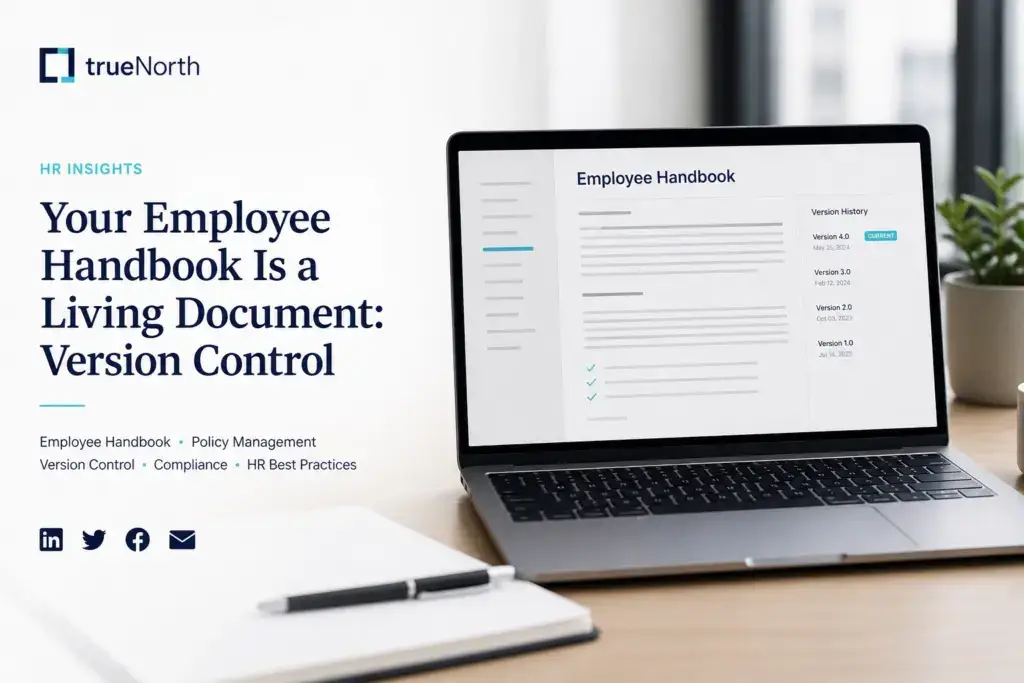
Most employee handbook risk does not sit in the wording. It sits in what you cannot prove: which version was in force on a given date, who received it, and who acknowledged the change. When a policy is questioned months later, an undated PDF and a folder of email attachments will not answer those questions.
That is why the strongest employee handbook is treated as a living document rather than an annual publication. The Employment Rights Act 2025 became law on 18 December 2025 and is being introduced in phases through 2026 and 2027, while Acas continues to flag record keeping and policy updates as priorities for HR teams. In practice, that means every version dated, every material change triggering a fresh acknowledgement, and every acknowledgement stored on the employee record with a timestamp.
This guide sets out what to version in your employee handbook, when a change should trigger re-acknowledgement, what a reviewer expects to see when a policy is questioned, a practical workflow for dating versions and chasing acknowledgements, the common pitfalls that break an audit trail, and where HR software fits as your system of record.
What Is an Employee Handbook, and Why a Living Document Beats an Annual PDF
An employee handbook sets out an employer’s policies, procedures and expectations in one place: holiday and absence rules, conduct, information security, and how managers apply those rules day to day. It sits alongside the contract of employment, which carries the enforceable terms, and applies across the workforce.
“Living document” is a structural point, not a slogan. A handbook is accurate only on the day it was issued. Law, Acas guidance and organisational change all move, so an annual refresh is a snapshot, and staff may be working from wording you never issued. The Employment Rights Act 2025 became law on 18 December 2025, with changes phased through 2026 and 2027, alongside fiscal measures covered in the 2026 Budget. Acas advises employers to keep checking the latest guidance, so several revisions in one year is normal.
Because Acas publishes free adaptable policy documents, wording is largely available. The operational gap is evidencing which version was in force, for whom, and when the employee was told. What follows is recommended practice, not a statutory checklist: a handbook counts as evidence only when every version is dated, every material change triggers re-acknowledgement, and each acknowledgement sits on an audit-ready employee record with a timestamp.
Why Employee Handbook Record Keeping Matters in the UK Right Now
Acas ranks updating policies and improving record keeping among HR teams’ priorities, noting that accurate records and clear audit trails show how decisions were made. That points to dated, traceable handbook versions.
Records showing compliance with holiday pay and annual leave rules must be kept for six years from the date they were made. Without the holiday policy version that applied to a pay period, compliance is hard to evidence. For multi-country employers, managing leave across borders compounds this, as each jurisdiction carries its own rules.
Documentation quality shapes discipline and grievance exposure: an unreasonable failure to follow the statutory Code of Practice can adjust a tribunal award by up to 25%. Last fully revised in 2009, the Code faces a 2026 consultation draft emphasising informal resolution and expecting employers to state what informal steps were taken, or why none were, before a formal hearing.
Day one leave rights do not always mean day one pay rights. Where wording and acknowledgement records do not show that distinction, staff may work from an assumption no one corrected.
Acas research found 44% of working-age adults in England, Scotland and Wales experienced conflict at work in the past 12 months. Documented policy application shows a decision followed a rule, not a manager’s mood.
No source directly governs handbook version control or acknowledgement, and this article does not assert what a tribunal requires in a given dispute. What follows describes what a reviewer, investigator or conciliator would reasonably expect to see.
Step 1: What to Version in Your Employee Handbook
Version discipline starts with deciding what counts as a version. Version every issued version, not every keystroke. Each one needs a unique, human-readable number and an issue date, for example Absence Policy v3.1, issued 6 April 2026. Hold one current version in one place; archive superseded versions rather than overwriting the file.
Separate administrative edits from material changes. Corrected typos, revised job titles, a new HR contact number or reordered clauses change the wording, not the deal. Log them, but they do not normally justify re-acknowledgement.
Define material change explicitly, as no official source does. A workable definition: any change that could affect pay, leave or another entitlement; the outcome of a disciplinary, grievance, absence or performance process; what a manager may require of an employee; or what an employee must do to meet a compliance obligation such as information security or data protection.
Version everything issued alongside the policy. Appendices, forms, schedules, manager guides and plain-English summaries each need their own number and issue date, because staff often read the summary rather than the policy. Version the communication too: emails, intranet posts, onboarding packs and all-staff announcements should quote the version number and issue date they point to, so the notice itself becomes evidence. Use a fixed cadence to review your policies and acknowledgements.
Record what changed and why. A one-line reason in the change log, whether a legislative update, revised Acas guidance, a restructure or a lesson from a tribunal case, turns a later explanation from reconstruction into retrieval.

Step 2: When a Change Should Trigger a Fresh Acknowledgement
Any material change to a policy an employee must follow triggers re-acknowledgement. State the scope clearly: everyone, or a defined group. An information security update might need acknowledgement only from staff handling personal data, but you must justify the scope you choose. Review your policies before each update so that choice is deliberate.
New starters should acknowledge the current version during onboarding, with the version number captured then. That gives each employee a clean, dated starting point rather than an inherited assumption.
For high-risk policies such as information security, data protection, health and safety and anti-bribery, run a scheduled re-acknowledgement cycle even when nothing material changed, kept separate from the material-change rule so neither blurs into a click-through exercise.
Contractual wording needs a different test. If a handbook term forms part of the contract, changes generally need mutual agreement unless a variation clause permits variation. Acknowledging a version is not agreeing a contract change, so decide which you are doing before describing it that way.
Watch for custom and practice, where a quietly abandoned rule becomes the effective arrangement. Dated versions and acknowledged updates make that drift visible while it can still be corrected.
Where a change introduces new statutory rights, pair the acknowledgement with a short explainer: a day one right to leave is not always a day one right to pay, and that difference must be spelled out, not inferred.
Step 3: What a Reviewer Expects to See When a Policy Is Questioned
When a decision is questioned, a reviewer is not assessing your policy wording but whether you can show which version applied, to whom, and that the employee knew. This is evidence quality, not a legal requirement: it is what a reviewer, investigator or conciliator would reasonably expect. Once those triggers are set, here is what the record must show.
A dated version history per policy. Every version, its issue date, what changed and why. For an absence decision made in March 2026, someone with no prior knowledge should identify the wording in force that month, including waiting-day changes under day one statutory sick pay (Day-One Statutory Sick Pay: Rebuilding Your Absence Rules).
Acknowledgement records held per employee. Each shows the version acknowledged and a timestamp, on the employee record. Not a shared spreadsheet, a mailbox, or a folder only one manager can find.
Scope evidence. Who was required to acknowledge, who did, who has not, and how non-completers were chased. A list of people who complied, without those who did not, is not a control.
Communication evidence. The channel, the notice date, and the wording staff received. If a manager explained the change in a team meeting, a short note confirms it happened.
The trail must be retrievable: policy version to acknowledgement to the decision affected. Where that needs manual reconstruction from three systems and an email search, the evidence exists but is slow and easy to challenge.
A Practical Workflow for Dating Versions and Chasing Acknowledgements

The evidence trail is only as reliable as the routine behind it. Run this workflow every time a policy moves.
- Assign an owner and a decision rule. One named person in HR, with a nominated approver, decides whether a change is administrative or material. Without that gate, every edit either becomes invisible or triggers a full re-acknowledgement round.
- Draft, approve, date and publish. Issue version N+1 with a version number and issue date, then archive version N as superseded. Never publish an undated document, and never leave two versions of the same policy in circulation.
- Trigger acknowledgement by scope. State the deadline, track completion, and escalate non-responders. A deadline without follow-up achieves the same as no deadline. Apply the same discipline to training renewals, as Expired Mandatory Training: Why a Spreadsheet Can’t Warn explains.
- Log each change with its reason and the external trigger it answers: Acas guidance, a phase of the Employment Rights Act 2025, a restructure or a specific workplace issue. The log turns the next question into a two-minute answer.
- Review on a cadence and on triggers. Quarterly suits the phased 2026 and 2027 changes, but any update to official guidance should start a review immediately rather than waiting for the scheduled date.
Common Pitfalls That Break the Audit Trail
Even a sound workflow fails if the trail it creates can be broken. Six habits do the most damage.
Silent overwrites. Replacing the PDF in the same shared folder without a new version number or issue date means nobody can later prove which text applied. The employer carries the doubt.
Undated filenames. A name like “final version 3” is not a version record. Version numbers and issue dates belong inside the document and in the system that holds it.
Acknowledgements kept off the employee record. Replies sitting in a line manager’s inbox, a spreadsheet abandoned in month two, or a signed page in one office cabinet are not retrievable evidence. Store them on the employee record with the version acknowledged and a timestamp.
Re-acknowledgement fatigue. Asking everyone to re-confirm everything trains staff to click through without reading. That lowers the quality of the evidence while creating an illusion of control. Target material changes and reserve scheduled cycles for genuinely high-risk policies.
Custom and practice drift. Where a policy says one thing and practice has said another for years, the employer’s position weakens, and it usually surfaces at the worst possible moment.
Treating an employee handbook update as a contract change. Contract changes generally need mutual agreement unless a variation clause applies. Acknowledged policy updates and agreed contract variations are two tasks with two different records. Confusing them creates disputes about what was agreed, when it started, and whether it was temporary or permanent.
With the pitfalls identified, the next question is where a system of record makes this evidence easier to produce.
Where Activ People HR Fits as Your Handbook System of Record
Closing those gaps is largely an operational problem, and it is where a system of record earns its place.
ACAS publishes free policy documents employers can adapt, so software is not the answer to policy wording. Its value is applying and evidencing policy: one place holding the current version, one place showing who acknowledged it and when.
Activ People HR covers company handbook, employee records and documentation, employee onboarding and training records. Those four areas map onto the four things this article asks for: a dated version, an acknowledgement trail, a record stored per employee, and a route for new starters to accept the current version.
The software is highly configurable, suiting small and medium sized employers that want one system, and larger corporates that use it as the employee-facing front end while data stays in enterprise systems. See how Activ People HR can help, then look at the company handbook, employee records and documentation, and onboarding and training records features to see how versioning, acknowledgement and records connect in practice.
Editorial note: verify with the product team that it dates versions, triggers re-acknowledgement and captures timestamps. Do not claim guaranteed compliance.
Conclusion: Make Your Handbook Prove Itself
A platform only helps if the underlying process is disciplined. Treat your employee handbook as an evidenced process, not an annual PDF, and start with three changes this month: put a version number and issue date on every policy and its appendices, and archive superseded versions rather than overwriting them; write down your working definition of a material change so re-acknowledgement is a rule rather than a judgement call, then apply it to the next policy you update and scope the acknowledgement group deliberately; and move acknowledgement records onto the employee record with a timestamp and the version acknowledged, with a deadline and escalation for non-completers.
Add a short change log entry with the reason for each revision, and review quarterly plus whenever official guidance moves. None of this is a legal requirement. The sources support record retention, policy currency and process documentation, not a prescribed handbook standard. Expect a reviewer to ask for exactly the trail described here.