The Fit Note Is Changing – Is Your Absence Management Approach Ready?
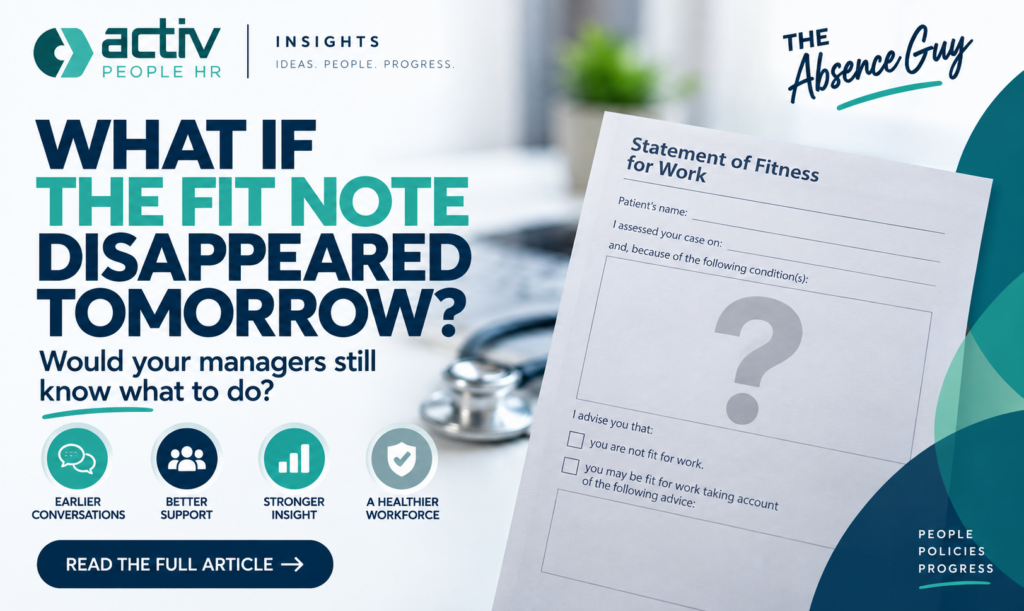
Fit notes are back in the spotlight.
Recent discussion about the future of the fit note system has raised an important question for employers: are we relying too heavily on a piece of paper to manage employee absence?
For many organisations, the fit note remains a key part of the sickness absence process. An employee is absent, a fit note arrives, it gets recorded and attention then turns to when the employee might return.
But effective absence management should start much earlier than that.
A fit note can provide useful medical guidance. What it cannot do is replace regular communication, good management, appropriate support and an understanding of an employee’s absence history.
A fit note is part of the process, not the process
A fit note may state that someone is “not fit for work” or “may be fit for work” with appropriate support.
That information matters.
But employers still need to understand what happens next.
Could temporary adjustments help? Would different hours make a return possible? Is a phased return appropriate? Has the employee experienced similar absences previously? Is there a wider pattern that needs to be discussed?
These are management questions rather than questions a fit note can answer on its own.
Don’t wait for the fit note to start the conversation
One of the risks with long-term sickness absence is allowing communication to reduce as the absence continues.
Managers may worry about contacting someone who is unwell. Employees can sometimes interpret a lack of contact as a lack of interest or support.
Neither outcome helps.
Appropriate and agreed contact can help both sides understand how things are progressing and what support may be available.
That doesn’t mean pressuring someone to return before they are ready. It means keeping communication open and making sure the employee knows what options and support are available.
The earlier those conversations happen, the more opportunity there may be to prevent an absence becoming unnecessarily prolonged.
Look beyond individual absences
This is also where good absence data becomes important.
Consider an employee who has had four separate periods of sickness absence.
Viewed individually, none of them may appear particularly concerning.
Viewed together, they could reveal a pattern.
Perhaps absences regularly occur around weekends. Perhaps the same health issue keeps recurring. Perhaps absence has increased following a change in role, workload or working arrangements.
Without accurate records, managers may never see that bigger picture.
And if different managers handle absence differently, the organisation can struggle to apply its policies consistently.
Return-to-work conversations matter
One of the simplest absence management tools is also one of the most valuable: the return-to-work conversation.
It gives managers an opportunity to welcome an employee back, understand the reason for their absence, check whether any support is needed and identify recurring issues.
It also reinforces the fact that absence is noticed and managed.
The conversation doesn’t need to feel formal or confrontational. In many cases, a short and supportive discussion is enough.
What matters is that it happens consistently and that relevant information and agreed actions are recorded.
The changing SSP landscape makes early management even more important
Changes to Statutory Sick Pay have increased the importance of knowing about sickness absence from Day 1.
That makes accurate reporting, consistent processes and early intervention even more important.
Employers need to know:
- Who is absent?
- Why are they absent?
- How long have they been absent?
- Have there been previous absences?
- Has the manager made appropriate contact?
- Are any actions or adjustments required?
- When should the absence next be reviewed?
If answering those questions involves searching emails, spreadsheets, paper forms and different systems, managing absence consistently becomes much harder.
What if the fit note disappeared tomorrow?
The current debate around fit notes gives employers a useful opportunity to review their own approach.
Ask yourself:
If the fit note disappeared tomorrow, would your managers still know how to manage sickness absence effectively?
Would they know when to make contact?
Would they know what questions they should ask?
Would they recognise a recurring absence pattern?
Would they know when an absence should trigger further action?
And could HR see what was happening across the organisation without having to chase individual managers for information?
If the answer to some of those questions is “no”, the issue may not be the fit note.
It may be the absence management process around it.
From recording absence to managing absence
Good absence management isn’t about trying to stop people taking legitimate time off when they are unwell.
It’s about having the information and processes to respond appropriately when absence occurs.
That means recording absence from Day 1, spotting patterns, prompting managers when action is required, completing return-to-work conversations and giving HR a clear picture of absence across the organisation.
Technology can help, but the starting point is getting the process right.
Because ultimately, a fit note can tell you that somebody isn’t fit for work. Good absence management helps you decide what happens next.
How healthy is your absence management process?
If you’re unsure how consistently your organisation manages absence, The Absence Guy’s 5-Minute Absence MOT provides a quick way to assess your current approach.
It looks at areas including recording and visibility, absence management, insight and analytics, policy and governance, and the employee and manager experience.
You’ll receive a personalised report highlighting where your current approach is working and where there may be opportunities to improve.
No obligation. No requirement to change your HR software. Just five minutes to take a closer look at how you’re managing absence.