Managing Leave in an International Organisation Is One of HR’s Trickiest Challenges
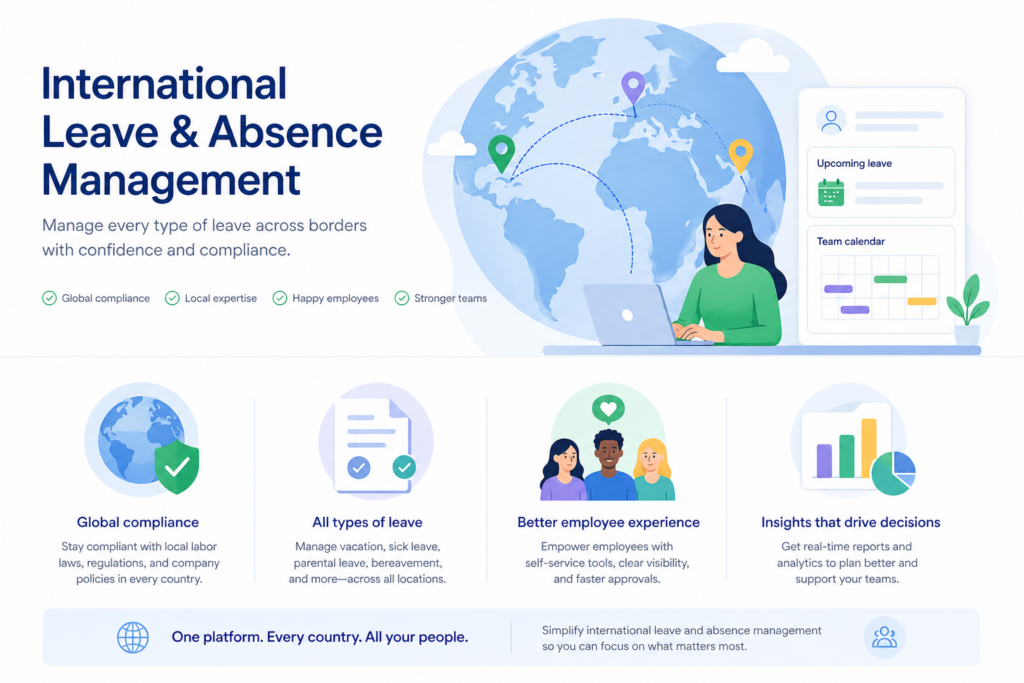
Managing Leave in an International Organisation Is One of HR's Trickiest Challenges
For multinational employers, managing holiday and absence is not just an admin task; it is a compliance challenge, a payroll challenge, and an employee-experience challenge all at once. Countries often use different leave years, accrual methods, carry-over rules, and special leave types, which means a single “vacation balance” rarely works across borders.
That is why a configurable leave management system matters. Activ People HR is designed to handle local rules flexibly, so organisations can manage statutory leave, company leave, special allowances, and benefit-linked absence rules from one platform.
Why Local Rules Differ
The biggest challenge is that leave entitlement is often defined by local law rather than by company policy. In France, annual leave typically accrues from 1 June to 31 May, and RTT (Réduction du Temps de Travail) 1st Jan to 31 Dec, this need to be tracked separately from standard holiday. In the Netherlands, statutory leave must be kept separate from non-statutory leave, and the rules for payout and expiry are different for each.
Denmark adds another layer of complexity. Holiday is earned across a 12-month period, but employees can usually use it across a 16-month entitlement window, so the earning period and usage period are not the same. Portugal, meanwhile, uses pro rata accrual for new starters before moving to a different annual structure after the first year, which creates another set of calculations for HR teams to manage.

More Country Examples
Some countries add leave types that are easy to overlook in a global policy. Italy includes additional time-off buckets such as ROL (Riduzione Orario di Lavoro) and Ex Festivita leave, which sit alongside annual holiday and need to be tracked separately. Hungary adds entitlement based on age and number of children, so leave can change as personal circumstances change.
Belgium can create a “year in arrears” problem, where the leave you earn this year affects the holiday you can take next year. That makes it much harder to manage entitlements manually, especially when a company operates across multiple countries and payroll calendars. Australia and New Zealand often use daily accrual models, which adds another variation for global HR teams.

Service-Based Entitlement
Some countries also require leave entitlement to increase automatically as employees gain service. Mexico is a strong example: after completing one year of employment, workers are entitled to at least 12 paid vacation days, with entitlement increasing by 2 days each year up to 20 days by the fifth year, and then by 2 days for every additional 5 years of service.
For multinational employers, this means leave systems must do more than track a balance; they must also apply seniority rules accurately and update entitlements at the right time. Without automation, these increases are easy to miss, especially when employees move between anniversaries, leave years, or countries with different working patterns.
Benefits Beyond Holiday
Holiday is only part of the picture. Many European employers also provide meal vouchers or daily meal credits, which are tied to days actually worked rather than just contractual leave. To calculate these correctly, HR teams must consider planned leave, sickness, and other absences so that employees receive the correct entitlement and employers stay compliant.
This is where manual processes become risky. A small error in absence coding can lead to incorrect accruals, missed entitlements, payroll corrections, or employee disputes. In a global organisation, those mistakes quickly become expensive and time-consuming.
Working With Corporate HR
Activ People HR can sit in front of corporate HR and People platforms such as Workday, handling the day-to-day complexity of leave management while keeping the core HR record clean and consistent. This is especially useful for multinational organisations where local absence rules, accrual methods, and leave balances need to be managed in detail at country level, but still reported back to the central HR system.
In practice, Activ People HR acts as the operational layer for leave administration. It manages local rules, approvals, accruals, exceptions, and benefit-linked absence logic, then feeds the resulting data back to the corporate platform so leadership has a single source of truth. That gives global HR teams the flexibility to manage local compliance properly without forcing every country into the same process.
This approach also reduces duplication and manual rekeying. Instead of trying to make a corporate HR platform handle every local rule directly, organisations can use Activ People HR to manage complexity at the edge and synchronise clean data back to the core system. The result is less admin, fewer errors, and better visibility across the business.

Configurability and Language
Activ People HR centralises different leave rules in one multinational system, so local logic can be configured once and applied consistently. That makes it possible to manage separate leave years, different accrual schedules, carry-over limits, country-specific balance types, and special allowances without maintaining dozens of spreadsheets.
The platform is also available in multiple languages, with more being added all the time, which helps global teams and local managers work in the language that suits them best. For international businesses, that matters because user adoption improves when people can use the system confidently in their own language.
For HR teams, that means less time spent checking balances, fixing errors, and answering repetitive leave queries. For managers, it means a clearer view of who is off and what capacity remains. For employees, it means the right balance is shown at the right time, with fewer surprises at year-end.

Business Impact
A configurable leave system helps multinational employers in three major ways. First, it reduces costly errors by applying local rules consistently instead of relying on manual interpretation. Second, it saves HR time by automating accruals, resets, carry-over, and multi-balance tracking across countries.
Third, it improves employee trust. When workers can see their entitlement clearly and know the system reflects their local rules, there are fewer disputes and less frustration. That is especially important in organisations where some employees accrue monthly, others annually, and others on a delayed or country-specific cycle.
A Better Global Model
The real lesson for international HR teams is that leave management is never one-size-fits-all. France, Denmark, the Netherlands, Portugal, Belgium, Italy, Hungary, Mexico, and other countries all show how entitlement rules can differ in timing, structure, and treatment of special leave. Add meal vouchers, attendance-linked benefits, multilingual user needs, and service-based increases, and the need for flexible software becomes even more obvious.
Activ People HR brings all of these rules together in one configurable platform, helping multinational employers stay compliant while saving time and reducing costly mistakes. It can also work alongside corporate HR platforms such as Workday, managing local operational complexity and feeding the results back into the central system for a clean, accurate view of workforce data.